
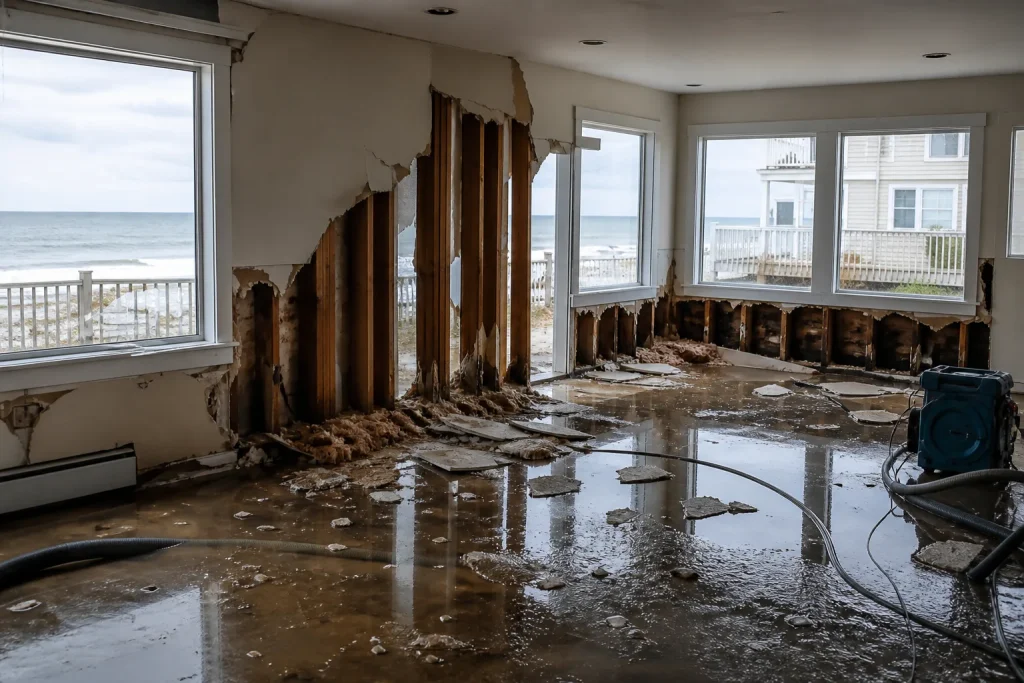
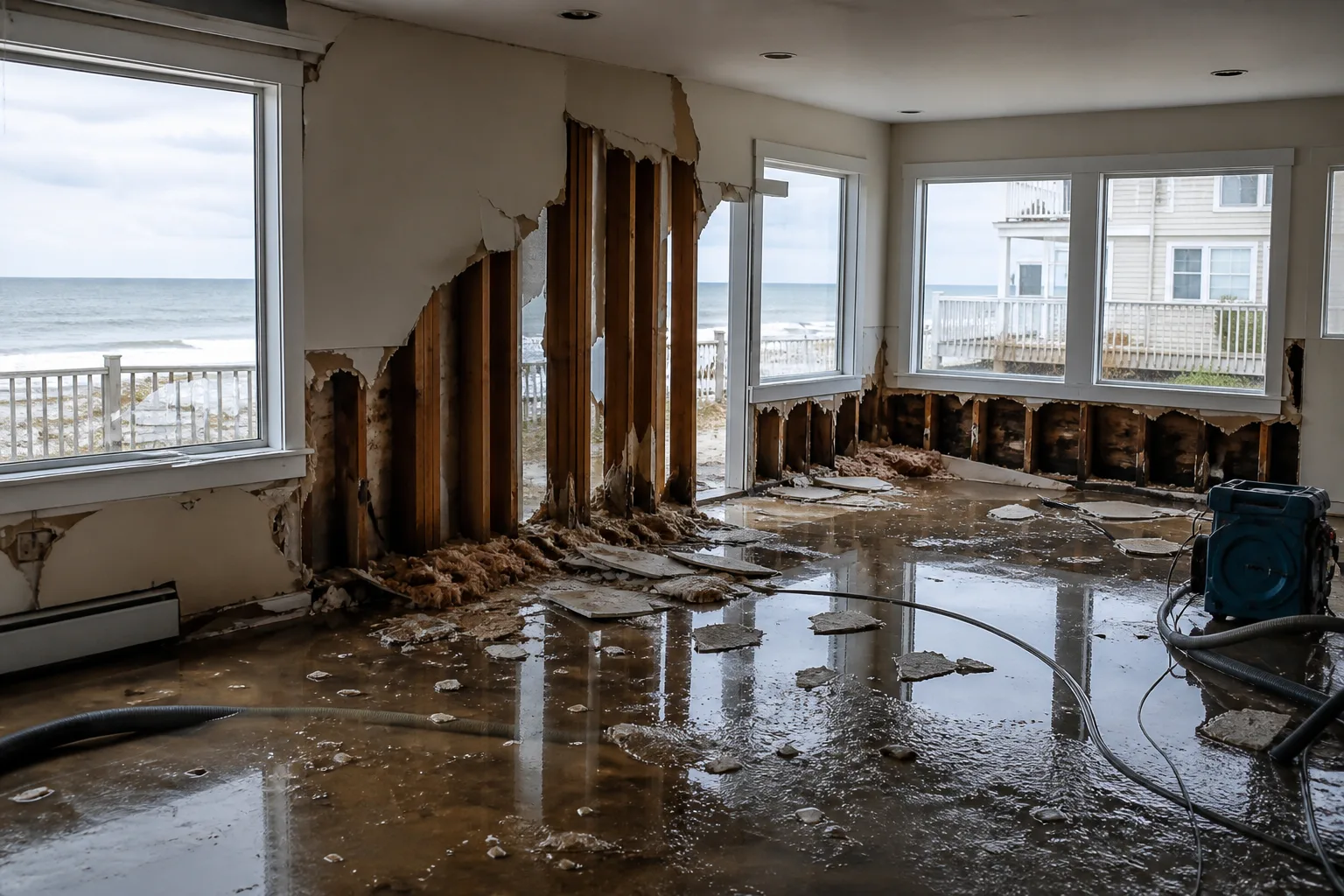
Emergency Water Damage Restoration Near Me: What Far Rockaway Homeowners Should Do First
If water is rising in your Far Rockaway home right now, the first thing to do is stop the source if you can do it safely, then cut power to affected areas from your breaker panel if that panel is above the water line. After that, take photos of everything before you move a single item. Those three steps, done in the first 15 minutes, determine whether your floors can be saved and whether your insurance claim starts clean. If you’d rather not handle any of it, call (845) 773-8058 and a live dispatcher will walk you through it while a crew rolls.
Most “what to do first” guides tell you to call a restoration company. That’s the third thing, not the first. The two steps before it decide what the crew finds when they arrive. Here’s the sequence, mapped to Far Rockaway’s specific housing stock and the way water actually behaves in attached homes and bungalows.
Key Takeaways
- Act in the first 15 minutes: stop the source, cut power safely, photograph everything before moving anything.
- Below-grade electrical panels are common in Far Rockaway and change entry safety during storm surge. Know where yours is before water rises.
- Never run a box fan into a wet wall cavity, use a shop vac on sewage-category water, or remove drywall before moisture mapping. Each mistake expands the damage.
- “Live answer at 2 a.m.” means a dispatcher picks up and a crew is dispatched. It doesn’t mean the crew is at your door in six minutes. Be wary of anyone who promises that.
- Insurance claims live or die on documentation in the first hour. What you don’t photograph costs you later.
The First 15 Minutes: Three Steps Before You Touch Anything
The first 15 minutes after water enters a Far Rockaway home are the only window where your actions meaningfully change the outcome. Everything after that belongs to professionals. Here’s the exact order.
Step 1: Stop the source, if you can do it without stepping into standing water
If a supply line burst under a sink or behind a toilet, shut the fixture valve. If you can’t find it or the break is in a wall, go to the main shutoff. In many Far Rockaway bungalows built before 1960, the main is under the house or in a crawl space that’s now full of water. If reaching it means standing in water or entering a below-grade space, don’t. Call us. We shut off water mains as a standard first action, and we have the proper gear to do it without creating an electrical hazard.
If the water is storm surge or sewage backup, there’s no “source” you can stop. Move immediately to Step 2.
Step 2: Cut power, but only if your panel is above the water line
This is the Far Rockaway-specific hazard most guides miss. A lot of attached homes and older bungalows here have electrical panels in basements or below-grade utility rooms, areas that flood first during coastal surge or a nor’easter. A live panel in standing water is a current running through the floor. Do not wade through that water to reach the panel. Do not send a family member down there. If your panel is below the water line, the power cut has to happen at the meter or by the utility or by a professional with the right equipment. That’s not a DIY moment.
If your panel is dry and accessible, flip the main breaker before you step into any wet area. And if you’re not certain the panel is dry, treat it as if it’s not.
Step 3: Photograph everything before moving a single item
Insurance documentation starts the moment the water stops. What you capture in the first 15 minutes is what the adjuster uses to establish the scope of loss. Here’s what “documenting for insurance” actually means with a phone camera.
Angles: Shoot wide shots of every affected room from all four corners. Then get close-ups of water lines on drywall, baseboards, and door casings. The water line, the stain, the buckling, the lifted laminate seam. Then shoot the source if it’s visible: the burst pipe, the failed water heater, the sewage backup point.
Timestamps: Your phone stamps them automatically, but say the time out loud in a short video walkthrough. “It’s 2:14 a.m., this is the kitchen, the water line is at 14 inches.” That video becomes evidence in a way a still photo can’t match.
Before you move furniture: Photograph items in place. Then photograph each item individually, including the maker’s mark or model number if it’s an appliance. A missing photo of a pre-damage condition is the single most common reason claims get underpaid. The adjuster never saw what you saw.
What a missing photo costs you: without documented pre-loss condition, the carrier can classify the item as “pre-existing condition.” In a Far Rockaway home with 20 years of coastal humidity, almost anything not photographed looks pre-existing to an adjuster who’s never met you. Photograph it before anything moves.
What Not to Do in the First Hour: Three Mistakes That Expand the Damage
In our 42 years of watching water damage get worse before crews arrive, these are the three homeowner actions that consistently turn a $4,000 mitigation into a $14,000 rebuild.
Skip the box fan pointed at the wall
It’s the most natural instinct in the world. A fan moves air. Moving air dries things. But a box fan aimed at a wet wall cavity pushes moisture deeper into the wall, into insulation, into the back side of the drywall, where it feeds mold growth in 24 to 48 hours. Far Rockaway’s summer humidity makes this worse. A wall cavity needs directed airflow at specific pressure differentials, which is what professional-grade equipment like Dri-Eaz and Injectidry systems are built to do. A box fan is not a substitute, and running one for six hours before calling us means we’re now drying a wall cavity that’s wetter than it was when the water stopped.
Do not wet-vac sewage-category water
If the water came from a toilet, a floor drain that backed up after heavy rain, or storm surge, it’s a Class 3 biohazard. A wet-dry shop vac does not filter pathogens, doesn’t contain aerosolized contaminants, and spreads the material across every surface as you drag the hose around. You also can’t dispose of the contents in the yard or storm drain. Sewage-category water in Far Rockaway requires containment, proper extraction, and disinfectant protocols, all of which our certified technicians handle with the right equipment and protective gear. Leave that to us and stay out of the room.
Leave the drywall where it is until someone reads the moisture map
It’s tempting to cut out the wet drywall and get a head start. But cutting before moisture mapping invalidates the drying plan. Our technicians use moisture meters and thermal imaging to map the extent of water migration, and that map tells us where to cut, where to dry in place, and where the water hasn’t reached yet. When a homeowner removes drywall before we arrive, we lose the water line evidence, we lose the migration pattern, and the insurance adjuster loses the documentation that ties the damage to this event. Keep the drywall in place. Take photos. Then let the moisture map guide the cuts.
What “Live Answer at 2 a.m.” Actually Means in Far Rockaway
Every restoration company says they’re available 24/7. Most mean a voicemail that gets checked in the morning. Ours doesn’t. When you call (845) 773-8058 at 2 a.m., a live dispatcher answers. That matters, and it’s worth understanding what it means and doesn’t mean.
What it means: A certified crew gets dispatched while you’re still on the phone. The dispatcher asks about the water source, whether power is cut, whether sewage is involved, and the square footage affected. That call determines what equipment is loaded on the truck and which technician leads the job. A live answer also means you’re not waiting until 8 a.m. to start the clock on mitigation. Water that sits overnight in Far Rockaway’s humid coastal air is water that’s already feeding the next problem.
What it doesn’t mean: No honest restoration company can promise a crew at your door in six minutes. Depending on where our crews are working and conditions on the Belt or Beach Channel Drive, realistic arrival in Far Rockaway is 45 to 90 minutes from the call. A company that promises faster than that is lying to you or sending whoever’s closest, certified or not. A live answer at 2 a.m. means the job starts the moment you hang up. Crew arrival follows the roads.
And in the meantime, the dispatcher stays on the line long enough to confirm you’ve shut the source safely and aren’t standing in water near a panel. That’s not scripted. It’s just how we’ve always worked.
Why the First 90 Minutes Belong to the Homeowner, and Everything After Belongs to Us
Here’s the line most guides blur. For the first 90 minutes, you are the only person on site. Your decisions either preserve evidence or destroy it. After that, the professionals take over because the work changes from documentation to drying science, and drying science is not something you improvise.
Our technicians arrived at a bungalow on the bayside of Far Rockaway in February after a water heater let go on the second floor. The homeowner had done everything right in the first hour: shut the main, cut power from a dry panel, photographed every room from every angle, and called us before touching the pool of water spreading across his kitchen floor. Because of that, we saved the original oak flooring. The claim was approved without a single adjuster dispute. He got his copy of the 90-Day Done Right Promise and the moisture log, and the carrier got the scope of work without argument. That’s what the first 15 minutes buys you when they’re done in order.
When the water is sewage-category or the electrical panel is in a flooded basement, skip the homeowner portion beyond Step 2 and call us. Here’s the honest breakdown of when to call a pro:
- Any water event involving storm surge or sewer backup
- A panel below the water line or any uncertainty about electrical safety
- A water source you cannot shut off without entering standing water
- Wall cavities, ceilings, or flooring already showing moisture after the first hour
- Any home with a history of prior water damage, which means hidden mold risk
Related services in Far Rockaway: our Water Damage Restoration in Far Rockaway page covers the full mitigation process from extraction to dry-down, and our Mold Remediation in Far Rockaway page explains what happens when water intrusion goes unaddressed for more than 48 hours and the moisture map shows mold.
How Insurance Works When Water Hits a Far Rockaway Home
Most homeowners in Far Rockaway have never filed a water damage claim before the night they have to. Here’s the short version of how it works and where it goes wrong.
Documentation is the claim. The photos you take in the first 15 minutes become the adjuster’s reference point. Every photo you don’t take is a line item the carrier doesn’t see. Your carrier will ask for the source of the water, the time it started, any repairs you’ve made in the last five years, and any prior claims. Have those answers ready and in writing.
Direct billing changes your role. A lot of restoration companies bill you and tell you to chase the carrier. We don’t. Floodline Restoration Co. bills the carrier directly. You never play messenger between us and the insurance company. The scope of work, the daily moisture readings, and the photos all go to the adjuster from us. You get a copy of everything.
A written scope before work starts. This is the protection a lot of Far Rockaway homeowners wish they’d had on their last contractor job. Before any equipment goes in, you get a written scope of work with upfront pricing. No surprises on the bill. No mid-job change orders that double the price. You sign what you agree to, and that’s what the carrier sees.
And every job, from a three-room extraction to a full rebuild, goes out backed by the 90-Day Done Right Promise. If it’s not done right, we make it right. In writing. No arguing. We’ve operated that way since Curt Bowman founded Floodline Restoration Co. in 2010, and it’s why we’ll still be answering the phone in Far Rockaway in thirty years.
The Bottom Line
The first 90 minutes after water enters a Far Rockaway home are yours. Stop the source if it’s safe. Cut power if the panel is dry and accessible. Photograph everything before you move a single item. Then call us. The mistakes we’ve covered here, the box fan, the shop vac on sewage, the drywall removal before moisture mapping, are the ones that turn a manageable mitigation into a complicated rebuild. Avoid them, document honestly, and the claim starts clean.
If you’re in Far Rockaway and need help, Floodline Restoration Co. home offers free estimates. Call (845) 773-8058 any hour. A live dispatcher answers. A certified crew rolls. And the 90-Day Done Right Promise means the job isn’t finished until it’s done right, in writing.
Frequently Asked Questions
We answer the phone live at all hours, and dispatch happens during that call. Realistic crew arrival in Far Rockaway is 45 to 90 minutes depending on where our trucks are working and road conditions. Anyone promising faster is not being honest with you. Call (845) 773-8058 and the dispatcher will give you a real ETA, not a sales line.
Most standard homeowner policies cover sudden and accidental water damage, like a burst pipe or failed water heater. Flood damage from storm surge requires separate flood insurance. Sewage backup often requires an endorsement. The single biggest factor in whether your claim is covered at fair value is the documentation you take in the first hour. Photograph everything before moving anything, and we’ll coordinate directly with your adjuster.
If you can see standing water or a visible water line on drywall, yes, you need professional drying. A box fan cannot dry a wall cavity, and moisture trapped in insulation feeds mold within 48 hours. The professional-grade equipment we use, including Dri-Eaz and Injectidry systems, is built for directed airflow and pressure differentials a household fan can’t replicate. The moisture map tells us what needs drying in place and what needs removal.
Stay out of standing water, especially if there’s any chance it touched an electrical outlet or panel. Keep children and pets away from the affected area. Do not move furniture or belongings. Call (845) 773-8058, and the dispatcher will walk you through anything else specific to your situation while the crew is en route.
Written by Curt Bowman, Owner at Floodline Restoration Co., serving Far Rockaway since 2010.
Need Damage Restoration Help?
Call Floodline Restoration Co. - licensed & insured, available 24/7 in Far Rockaway.
(845) 773-8058